How to Choose Affordable FR T-Shirts Without Compromising Protection
Buying flame-resistant workwear on a budget does not mean choosing the lowest-priced shirt available. A better approach is to confirm the protection required for the job, then compare fit, fabric, construction, care needs, and expected service life. This helps buyers control spending without making price the only deciding factor.
The shirt must work for the person wearing it, while the purchase decision should also account for durability, replacement frequency, and long-term value.
Start With the Required Protection
Before comparing prices, buyers should confirm what the job requires. Electrical work, welding, oil and gas operations, construction, and industrial maintenance may involve different hazards, so one shirt will not suit every setting.
The employer’s hazard assessment should guide the choice. Buyers should review the garment label and product specifications for the relevant standards, arc rating, category, or intended use. General phrases such as “heavy duty,” “protective,” or “industrial” are not enough on their own.
The safer order is to confirm the required protection level first and compare only products that meet it.
Look Beyond the FR Label
An FR label is important, but it does not tell buyers everything they need to know. Fabric construction, closures, cuffs, seams, and overall coverage also affect how practical the shirt will be during daily work.
When comparing FR T-shirts, check the neckline, sleeve length, body length, and fit through the shoulders and torso. A shirt that rides up while climbing or bending may leave part of the body exposed. A shirt that is too tight can restrict movement, while one that is too loose may catch on tools or equipment.
Buyers should also avoid treating an ordinary cotton work shirt as a substitute for properly selected flame-resistant clothing. Fabric appearance and thickness do not confirm protective performance.
Choose a Style That Fits the Task
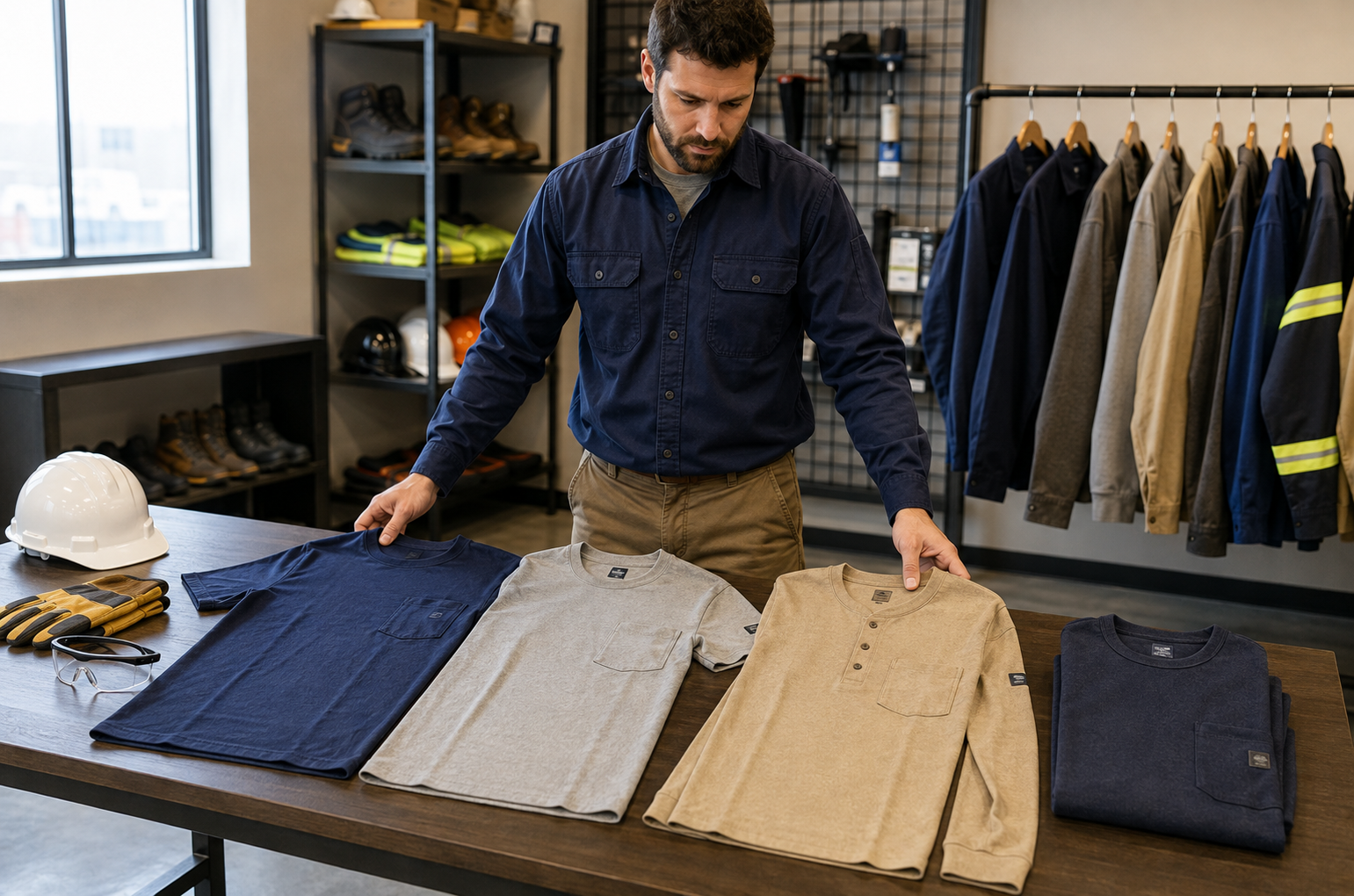
FR work tops come in several styles, including crew necks, Henley shirts, buttonless pullovers, long-sleeve tees, and vented designs. The best option depends on the work itself.
Crew necks have a simple construction with fewer front components. Henley shirts may be easier to put on and offer a traditional workwear fit. Buttonless pullovers reduce exposed front hardware, while long sleeves provide more coverage where the arms must remain protected.
Workers who wear harnesses, outer layers, or high-visibility vests should also consider how the shirt fits with the rest of their equipment. A chest pocket may be useful for one trade but inconvenient under straps or other PPE.
Compare Fabric Weight and Comfort
Fabric weight can affect comfort, especially during long shifts or hot-weather work. Lighter material may feel less restrictive, but the lightest shirt is not automatically the best value.
The fabric still needs to withstand movement, abrasion, repeated washing, and normal jobsite wear. A shirt that feels comfortable at first but quickly loses shape or develops weak seams may cost more over time.
Comfort should be judged across a full shift. Workers need enough room for reaching, lifting, climbing, and bending. Seams should not rub against the skin, cuffs should stay in place, and the shirt should remain long enough to provide coverage when the wearer moves.
Base layers also need attention. Buyers should check the employer’s clothing policy before pairing FR garments with ordinary synthetic athletic shirts. The full clothing system should be suitable for the hazard.
Check Durability Before Focusing on Price
A low purchase price is only useful when the garment remains wearable. Buyers should inspect reinforced stress points, seam quality, collar construction, cuff design, and closure strength.
Product descriptions should also explain how the shirt is expected to perform after repeated laundering. Preshrunk or prewashed fabric may help with fit consistency, but care instructions still need to be followed.
For employers ordering multiple shirts, durability becomes even more important. Replacing an inexpensive garment several times can cost more than buying a better-constructed option at the beginning.
Calculate Long-Term Cost
A useful comparison goes beyond the listed price. Buyers should consider purchase cost, expected service life, washing requirements, replacement frequency, return conditions, and how often the shirt will be worn.
This is where an affordable FR clothing brand should be judged carefully. Clear product specifications, sizing information, care instructions, and return terms help buyers avoid ordering garments that do not fit the job or the wearer.
Cost per wear can be more useful than the initial price. A slightly more expensive shirt may be the better value when it keeps its fit and lasts through more wash cycles. A cheaper option may become expensive if it needs frequent replacement.
Watch for False Economy
Buyers should be cautious when a product listing does not provide fabric details, protection information, sizing guidance, or care instructions. Vague terms such as “fireproof,” “safety shirt,” or “industrial grade” do not explain how the garment was evaluated.
Deep discounts may also apply to limited sizes, discontinued colors, or final-sale items. Those products may still be useful, but return restrictions should be checked before purchase. A shirt has little value if it cannot be exchanged and does not fit safely.
Maintain and Inspect Every Shirt
Even a well-chosen shirt needs regular care. Workers should check for holes, worn cuffs, damaged closures, pulled seams, and contamination from oil, grease, chemicals, or flammable materials.
Care instructions should be followed closely, and replacement should be based on condition, fit, contamination, and manufacturer guidance rather than age alone.
Keeping several FR T-shirts in rotation can reduce wear on any single garment and make it easier to keep clean shirts available throughout the workweek.
Final Thoughts
The best budget choice is not the cheapest shirt. It is the one that provides the required protection, fits the worker properly, holds up to normal use, and remains practical to maintain.
Buyers evaluating an affordable FR clothing brand should compare ratings, fabric, construction, fit, care requirements, and long-term cost before making a decision. That approach keeps spending under control without treating worker protection as the place to cut corners.