Sidewalk Machines vs Shovels: The Productivity Showdown That Reveals What Actually Scales
Coquitlam and Tri-Cities winter coverage
A shovel can clear almost anywhere. A sidewalk machine can clear a lot more ground. Neither fact tells a commercial property manager which approach will actually perform better during a storm.
The useful comparison begins with the site. Good commercial sidewalk snow removal equipment should match the width of the route, the number of obstacles, expected accumulation, pedestrian traffic and the amount of ground crews must cover before people arrive.
Consider two properties. One has a long, mostly straight walkway connecting several buildings. The other has short paths interrupted by stairs, benches, planters, doors and tight corners. Sending the same crew setup to both would make little operational sense. Machines scale through repeatable movement. Shovels scale through access and precision. The real question is where one stops being efficient and the other starts earning its place.
Machines Win the Long Run – Literally
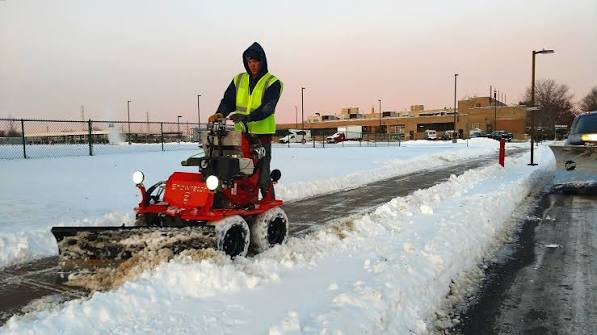
A dedicated sidewalk machine is strongest when the operator can keep moving.
Long walks, broad pedestrian routes and connected commercial campuses give compact equipment room to build productivity. Instead of repeatedly lifting and throwing snow, an operator can push accumulation along a predictable route and continue to the next section.
The advantage gets larger as the route gets longer.
Distance Rewards Mechanization
Imagine a straight walkway that runs several hundred metres around a commercial property.
A manual crew must physically cover every metre while moving the snow. Even if accumulation is light, the work remains repetitive.
CCOHS illustrates how quickly manual workload can add up: its snow-shovelling guidance notes that moving a typical 5 kg shovel load every five seconds can amount to roughly 1,000 kg of snow moved in just 15 minutes. It also describes snow shovelling as strenuous work affecting both the heart and back.
Machines reduce that lifting component while increasing the amount of continuous surface one operator can address.
Machines Still Need Room to Work
Speed disappears when the machine is constantly stopping.
Bollards, narrow gates, utility boxes, sharp corners, parked bicycles and changes in sidewalk width can turn an efficient machine route into a sequence of awkward manoeuvres.
Equipment selection therefore cannot start with horsepower or blade width.
Start with the route.
If an operator spends half the time reversing, repositioning or avoiding obstacles, the productivity advantage on the specification sheet will never appear on the property.
Where Shovels Still Earn Their Keep
Calling shovels outdated misses how commercial sites actually work.
Machines are good at clearing the middle of accessible surfaces. Properties, however, are full of edges.
Snow collects beside doors. Steps need attention. Corners around planters cannot always be reached mechanically. A blade may pass close to a wall while leaving a narrow strip behind. Pedestrian entrances need more detailed work than a long exterior sidewalk.
This is where manual crews remain valuable.
A worker can move through a narrow gap, clear a threshold, finish a stair landing and reach areas where bringing a machine would waste more time than it saves.
There is also a precision advantage. Close to building finishes, curbs and other vulnerable features, a shovel gives an experienced worker direct control over where the snow moves.
For complex properties, removing manual labour entirely is not scaling. It is simply moving the bottleneck to all the places the machine cannot finish.
Sidewalk Equipment Selection by Site Layout
A useful equipment plan divides pedestrian areas into categories before winter.
First are machine-friendly routes: long, continuous sidewalks with predictable widths and few obstructions. These are the places where mechanization can materially reduce service time.
Second are mixed routes. A machine can handle the main surface, but workers are needed at doorways, corners, curb transitions and other detailed areas.
Third are manual-only zones: stairs, narrow passages, small landings and spaces where equipment cannot safely manoeuvre.
Snow conditions matter as well.
Light fresh accumulation behaves differently from wet, compacted snow. CCOHS recommends removing snow early and often where possible because fresh, dry snow is generally lighter and easier to manage than wet, packed or partly melted accumulation.
That principle affects both methods. Earlier service can keep machines moving efficiently and make remaining manual work less demanding.
The best equipment plan is therefore connected to timing, not simply inventory.
The Bottleneck Is Usually the Handoff
A property can have excellent machines and still end up with poor sidewalk service.
The problem is often sequencing.
Don’t Leave the Detail Crew a Mountain of Work
Suppose the machine operator clears every main walkway first and leaves entrances, stairs and tight corners untouched until the end.
The property may appear mostly cleared, yet the surfaces pedestrians use most heavily could still be waiting.
A better sequence lets mechanical and manual work complement each other. As the machine opens longer routes, workers finish priority entrances and transitions rather than following far behind.
That reduces the period when a walkway is technically open but not actually complete.
Ice Control Is a Separate Decision
Neither a machine nor a shovel solves every winter hazard.
Once bulk accumulation is removed, compacted patches, refreeze and changing surface conditions may still require granular ice control and follow-up inspection.
The important distinction is operational. Snow clearing moves accumulation. Ice control addresses traction. A scalable service plan needs both jobs assigned rather than assuming one automatically completes the other.
Building a Scalable Sidewalk Service Plan
For a commercial contractor, scale does not mean replacing five people with one machine everywhere. It means using labour where human access creates value and equipment where continuous movement creates value.
That is also where the operating approach of Limitless Snow Removal fits the comparison.
Modern equipment supports faster clearing across machine-friendly surfaces, but reliable service still depends on crews understanding the property. Twenty-four-hour availability matters when sidewalks must be ready before early traffic or conditions change overnight. Safety-focused ice control addresses what remains after bulk snow is cleared, while scheduled plans establish routes and priorities before equipment arrives.
Transparent pricing also helps property managers compare service plans on something more useful than the number of machines assigned to a site.
The best question is not, “How much equipment does the contractor own?”
Ask how the property will actually be cleared.
Which routes are mechanical? Which require hand work? What gets opened first? How are entrances finished? Who handles refreeze? What happens when accumulation becomes heavier than expected?
A shovel is not automatically inefficient, and a machine is not automatically scalable.
Put either one in the wrong place and productivity disappears.
Put both where they belong, and the sidewalk operation starts to scale.