Wine, Cheese & Chocolate Gifts: A Practical Buying Guide
Somewhere in most people’s kitchens is a gift basket that never got opened. Shrink-wrapped, ribboned, full of shelf-stable cheese spread and a bottle nobody recognized — it sat on the counter for three weeks and then quietly went into a cupboard.
I’ve given that basket. I’ve also received it. After a few years of paying attention to which food-and-drink gifts got eaten and which didn’t, the pattern turned out to be simple: the good ones were built around a moment, the bad ones around a price point.
A bottle of wine is a nice thing to hand someone. A bottle with the right cheese or chocolate beside it is an evening — a meaningfully different gift. Here’s how to choose one that gets opened the same week it arrives.
Start With What They Drink, Not What Impresses
The most common mistake in wine gifting is buying up. You reach for the label you’ve heard of, or the most expensive bottle in your budget, and hand someone a big tannic Cabernet when they drink Prosecco on the porch.
Match the person:
- The casual drinker. They want approachable, not impressive. Prosecco, Moscato, a soft Pinot Noir. Sweetness and low tannin are features here, not compromises.
- The enthusiast. They already own good bottles, so give them something they’d be curious about rather than something famous — a single-vineyard bottling, an unfamiliar region, a producer with a story.
- The griller or steak lover. Structure and dark fruit: Cabernet, Malbec, Syrah. If you want to get the match right for a specific cut.
- The person you barely know. Champagne or a good Brut sparkling. It’s the closest thing to a universally welcome bottle, and it doesn’t presume to know their taste.
And the honest caveat: if there’s any chance alcohol isn’t welcome — recovery, pregnancy, religious observance, or you simply don’t know — skip the wine entirely. A serious chocolate or cheese gift stands on its own, and getting this wrong costs far more than getting it right gains.
Why a Pairing Beats a Bottle Alone
A bottle by itself gets absorbed into the wine rack. A bottle with something to eat alongside it gets a date on the calendar.
That’s the real argument for a paired gift, and it’s worth understanding before you shop:
- It removes a decision. The recipient doesn’t have to figure out what to serve with it.
- It suggests an occasion. Paired gifts get opened with someone else, which is usually the point.
- It makes a modest bottle taste better. A $30 wine with the right aged cheese genuinely outperforms a $50 wine eaten with nothing.
That last point is the one most people miss. Pairing isn’t decoration on top of the gift — it changes how the wine actually tastes.
Choosing a Wine and Cheese Gift
Cheese is the easier of the two pairings to get right, because the classic matches are classics for a reason. What separates a good wine-and-cheese gift from a forgettable one is the quality of the cheese, not the price of the wine.
Look for:
- Real cheese, not spread. Shelf-stable cheese products are the single clearest sign of a filler basket.
- Texture range, not regional theming. A fresh cheese, a semi-firm, and something aged will show off a wine far better than three cheeses from the same country that all taste soft and buttery.
- Accompaniments that do work. Honey, quince paste, Marcona almonds, and something acidic like cornichons. Crackers are fine; crackers alone are thin.
- A wine with acidity. Acid cuts fat. This is why sparkling wine and Sauvignon Blanc are so reliable with cheese, and why a heavy oaked red can be a harder match than people expect.
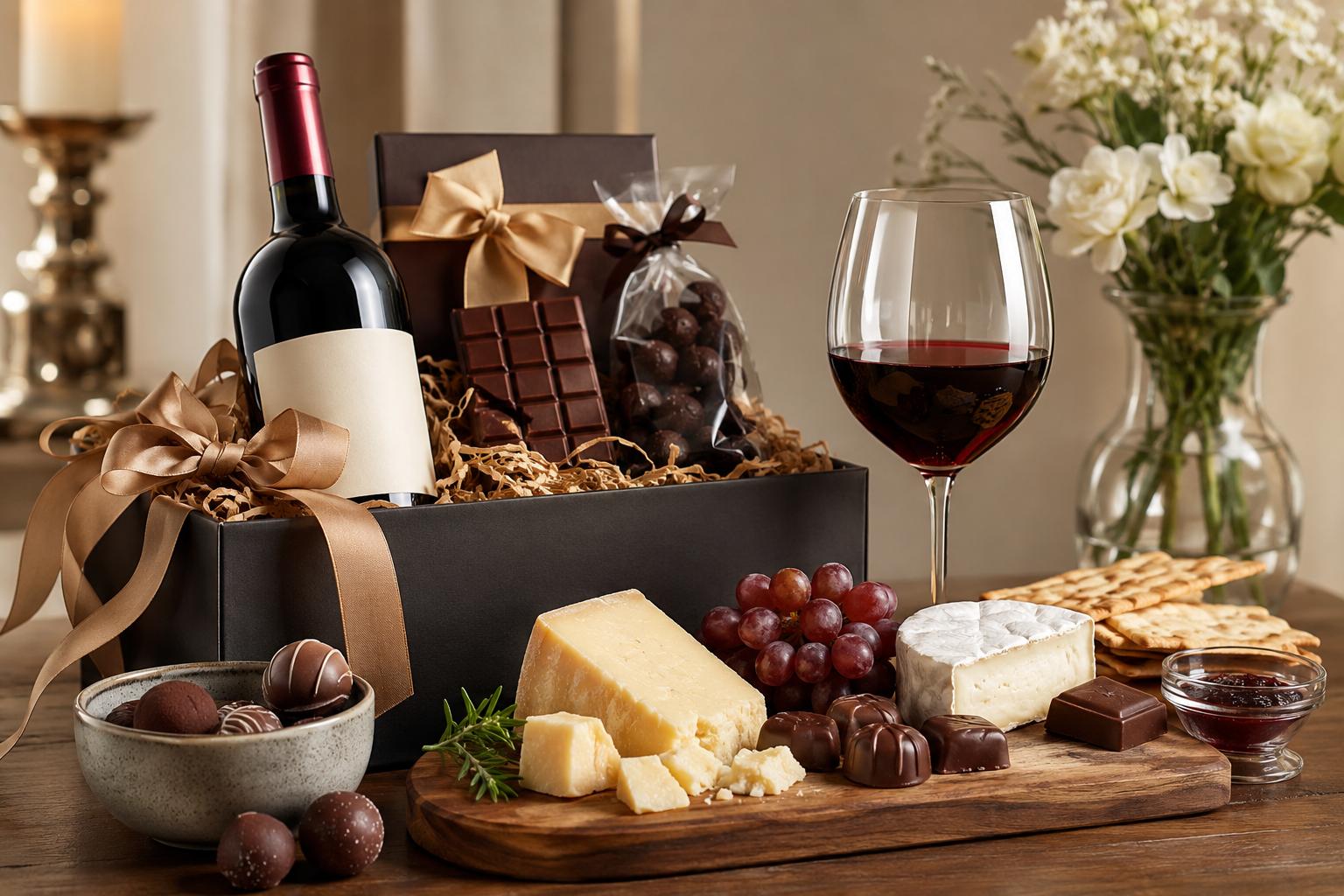
Curated wine gift baskets solve the matching problem when you don’t have time to shop three counters — but apply the same checklist to a pre-built set that you’d apply to one you assembled yourself.
One practical note: cheese has a shelf life and a temperature preference. If the gift is shipping across the country in July, or landing at an office where nobody knows when the recipient will collect it, chocolate is the safer choice.
Matching the Gift to the Occasion
The same box reads differently depending on why you’re sending it.
- Hostess or dinner-party gift. Something that doesn’t demand to be opened that night. A sparkling wine and chocolate travels well and puts no pressure on the host.
- Thank-you. Warmth over grandeur. Mid-range, well-chosen, with a handwritten note that names what you’re thanking them for.
- Client or corporate. Check the recipient’s company gift policy first — many have value caps. Presentation matters more here than anywhere else, and shelf-stable contents are a genuine advantage when you don’t know the delivery timing. Wine and chocolate gift baskets tend to work well for this reason: nothing spoils if the box sits at a front desk overnight.
- Birthday or anniversary. This is where personalization earns its cost — an engraved bottle or a vintage matched to the year turns a consumable into a keepsake.
- Sympathy. Lean toward food over alcohol. Something the household can share with visitors, requiring no preparation.
How to Tell a Good Basket From a Filler Basket
Once you start looking, the difference is easy to spot:
- Named producers. A good set tells you the winery and the chocolatier. A filler basket says “premium red wine.”
- A sensible ratio. One good bottle and three excellent accompaniments beats one bottle and twelve mediocre ones.
- Contents that were chosen for each other. The test is whether the wine and the food were selected as a pairing, or whether a bottle was dropped into a pre-existing snack box.
- Packaging that survives shipping without being so elaborate that half the value is cardboard.
- Clear delivery terms, particularly for alcohol, which has state-by-state shipping restrictions in the US that catch a lot of first-time senders out.
Specialist gifting retailers — Wine and Champagne Gifts among them — build sets around pairing logic rather than assembling generic boxes, which is generally the difference between a gift that gets opened and one that gets re-gifted.
What to Expect at Each Budget
- Under $50. One well-chosen bottle plus one good accompaniment. Don’t stretch this into a full basket; you’ll end up with filler.
- $50–$100. The sweet spot for most occasions. A genuinely good bottle and two or three real accompaniments.
- $100–$200. Recognizable producers, better chocolate or a proper cheese selection, and packaging that reads as a gift.
- $200+. Reserve for milestones. You’re buying a specific bottle someone will remember; the accompaniments are supporting cast.
FAQ
Is a wine gift basket a good gift, or is it a cliché?
It’s a cliché when it’s generic and a strong gift when it’s specific. A basket assembled around what the recipient actually drinks reads as thoughtful; a shrink-wrapped assortment reads as an errand.
What wine should I gift if I don’t know their taste?
Brut Champagne or a quality sparkling wine. It’s celebratory, low-risk, and works at almost any temperature of relationship.
Can you ship wine gifts anywhere in the US?
Not everywhere. Several states restrict direct-to-consumer alcohol shipping, and some require an adult signature on delivery. Check the retailer’s shipping map before you order, especially for a time-sensitive occasion.
Should I choose cheese or chocolate?
Chocolate if it’s shipping long-distance, going to an office, or arriving at an unknown time. Cheese if it’s arriving into someone’s hands quickly and you know they’ll open it soon.
How much should I spend on a corporate gift?
Many companies cap gift values around $50–$100 per recipient. Ask, or check the recipient’s published policy — an over-budget gift creates an awkward obligation rather than goodwill.
The Thing Worth Remembering
A good food-and-drink gift isn’t about spending more. It’s about handing someone something they can use without having to plan around it — a bottle they’ll enjoy, with something beside it that makes the bottle taste better.
Buy for the person rather than the occasion, keep the contents few and good, and match the perishability to how the gift will travel. Do those three things and it won’t end up in the cupboard.
Disclaimer
The information provided in this article, “Wine, Cheese & Chocolate Gifts: A Practical Buying Guide,” is intended for general informational and educational purposes only. It is not intended to constitute professional, legal, financial, dietary, or medical advice.
Any recommendations regarding wine, cheese, chocolate, food pairings, gift baskets, pricing, product quality, or retailers are based on general considerations and may vary depending on individual preferences, availability, location, season, and market conditions. Product prices, shipping policies, delivery times, and availability may change without notice.