Storefront Signage in Los Angeles: Why Your Sign Is Either Pulling Customers In or Pushing Them Away
A faded sign, a crooked channel letter, a font so ornate no one can read it from a moving car. These aren’t just aesthetic problems. They’re revenue problems. Research from FedEx Office has found that nearly 76% of consumers say they entered a store they had never visited before simply because of its sign. Flip that statistic around, and the implication is hard to ignore: a weak sign doesn’t just fail to attract people, it actively costs you foot traffic you never knew you were losing.
In a city as visually saturated as Los Angeles, the stakes are even higher. Your storefront is competing with hundreds of other businesses for the attention of people who are often moving fast, distracted, and making split-second decisions about where to stop.
First Impressions Happen Before Anyone Walks Through the Door
Most business owners think about signage after everything else is settled. The lease is signed, the interior is designed, the products are stocked. Then, almost as an afterthought, comes the sign.
That sequencing is a mistake.
Your sign communicates before your staff, your website, or your window display gets a chance. It tells someone whether you look established or makeshift, whether your brand is premium or discount, whether you belong in this neighbourhood or ended up here by accident.
In areas like Beverly Hills, West Hollywood, or Santa Monica, that first impression carries real commercial weight. Shoppers in those corridors are making constant, unconscious assessments about where to spend their time and money. A sign that looks tired or generic signals that the business behind it might be too.
Getting this right starts well before fabrication. A proper site survey of your location gives you critical information about lighting conditions, sightlines, building facade materials, and any restrictions that affect what you can install and where. Skipping this step is one of the most common reasons businesses end up with signage that underperforms from day one.
What Makes a Storefront Sign Actually Work
There’s a difference between a sign that looks good in a mockup and one that works in the real world. Several factors determine whether your signage converts attention into footfall.
Legibility at Speed and Distance
Most people approaching your storefront are either driving, cycling, or walking quickly. That means your sign needs to communicate your business name, and often your category, within a second or two.
Practical rules that consistently hold up:
- Letter height matters more than font. At 100 feet, you need letters at least 10 inches tall for comfortable readability. Many business owners go smaller to look refined and end up invisible.
- High-contrast combinations work. Dark text on a light background, or vice versa, outperforms trendy low-contrast pairings almost every time in real-world conditions.
- Script fonts are a trap. They look elegant in isolation but become unreadable at any distance, especially in mixed lighting.
Illumination After Dark
Los Angeles doesn’t shut down at sunset. Restaurants, bars, retailers, and service businesses all benefit significantly from signs that remain legible and attractive after dark.
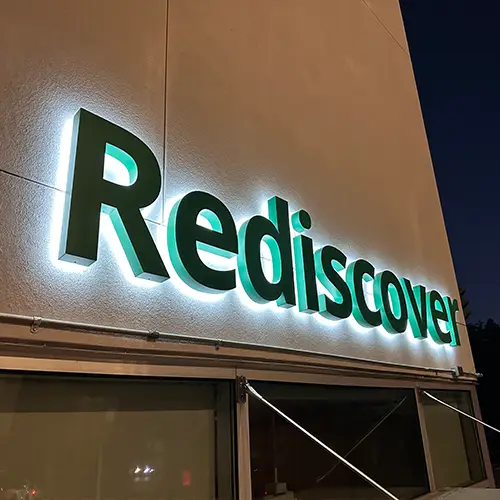
Backlit signs and channel letters are among the most effective options here. Internally illuminated letters give a clean, polished look and are visible from a considerable distance without creating the harsh glare that older neon could produce. Speaking of neon, though, its comeback in LA is worth noting. Vintage-style neon signs have become genuinely powerful branding tools for certain hospitality and retail concepts, particularly in neighbourhoods like Silver Lake, Echo Park, and Downtown LA.
The key is matching the illumination type to the brand. A law firm in Pasadena and a cocktail bar in Hollywood have very different needs, and their signage should reflect that.
Material and Build Quality
Cheap materials announce themselves. Corrugated plastic, peeling vinyl, and oxidised aluminium all communicate the same thing: this business cut corners.
In the long run, investing in quality fabrication, whether that’s aluminium composite panels, brushed stainless steel, or precision-cut acrylic, pays off. These materials hold up against UV exposure, coastal humidity, and the occasional pressure wash. LA’s climate is gentler than most, but sun exposure alone will destroy inferior materials within a few years.
The Permitting Problem Nobody Tells You About
Here’s something many new business owners don’t find out until it’s too late: Los Angeles has some of the most complex municipal sign permitting requirements in the country. Zoning regulations vary by district, building classifications affect what’s permitted, and certain neighbourhoods have additional overlay restrictions that aren’t obvious from a quick search.
Getting this wrong can mean removal orders, fines, or the forced replacement of signage you’ve already paid for and installed.
The permitting process typically involves:
- A site assessment to determine what the building and zoning code allows
- Engineering drawings for any externally mounted or structural signage
- Submission to the appropriate city department (often the Department of Building and Safety)
- Inspection upon installation
Working with a sign company that handles permitting in-house is genuinely worth prioritising. It removes a significant source of delay and risk. Companies that outsource this step, or expect the client to handle it, create friction that can push back a grand opening by weeks.
Common Signage Mistakes LA Businesses Make
Even experienced operators get this wrong. A few patterns show up repeatedly across storefront signage in the city.
Choosing size based on aesthetics rather than visibility. A sign that looks proportionate in a design file can disappear on a busy commercial facade. Real-world sightlines and competing visual noise need to factor into the size decision.
Ignoring the approach angle. If your entrance is on a corner, or customers approach from a specific direction, your primary sign needs to face that approach. Businesses regularly install signage that’s only fully visible from directly in front, missing everyone coming from the dominant foot traffic direction.
Treating signage as a one-time purchase. Signs require maintenance. Burnt-out letters, cracked faces, and faded vinyl all accumulate gradually and become invisible to the people who see them every day. Passersby notice before you do.
Underestimating wayfinding. In larger commercial properties, multi-tenant buildings, or complexes with parking lots and rear entrances, wayfinding signage is as important as the primary storefront sign. People who can’t find you easily won’t try twice.
Key Takeaways
- Your storefront sign is making an impression on potential customers before any other touchpoint. A weak sign actively reduces foot traffic, not just fails to generate it.
- Legibility, illumination, and material quality are the three practical pillars of effective storefront signage. Treat any one of them as secondary and the whole system underperforms.
- LA’s permitting process is genuinely complex. Working with a sign provider who manages this in-house reduces delays and legal risk significantly.
- A site survey before fabrication is non-negotiable. Building materials, sightlines, and municipal restrictions all affect what sign will work for your specific location.
- Signage is not a set-and-forget investment. Scheduled maintenance keeps your brand looking intentional rather than neglected.
FAQ
How long does the signage process typically take for a Los Angeles storefront?
Timelines vary by project scope, but a realistic range for a custom illuminated sign in LA, including design, permitting, fabrication, and installation, is six to ten weeks. Projects in areas with stricter zoning overlays or that require engineering certification can run longer. Planning ahead is genuinely important, especially if you have a fixed opening date.
Do I need a permit for every type of sign in Los Angeles?
Most externally mounted signs require a permit, including channel letters, monument signs, and illuminated cabinet signs. Some temporary and window signage is exempt, but regulations vary by zone and building type. Assuming you don’t need a permit without checking is a common and costly mistake.
What type of sign works best for a retail storefront with a lot of foot traffic?
For high-footfall retail locations, backlit channel letters or halo-lit signs tend to perform well because they’re readable in both daylight and low light. Monument signs are effective for businesses set back from the street or in plazas. The right answer depends on your specific building, brand positioning, and customer approach path, which is exactly why a thorough site assessment matters before committing to a format.
Who handles historical sign restoration in Los Angeles?
Historical sign restoration is a niche service that not every sign company offers. It requires knowledge of original fabrication techniques, period-appropriate materials, and often coordination with heritage preservation bodies. If you manage a landmark property in LA, finding a company with documented restoration experience is important, as the work is considerably more complex than standard sign installation.
How do I find a reliable sign company for my LA business?
Look for a company with a full-service in-house process covering design, engineering, permitting, fabrication, and installation. Local experience is particularly valuable in LA given the permitting complexity. Los Angeles Sign Company has been operating in the LA market for over 20 years and handles the complete process from initial survey through to post-installation maintenance, which is the kind of continuity that prevents things from falling through the cracks.
Closing Thoughts
Signage is easy to underestimate because it doesn’t change after it goes up. It just sits there. But that’s exactly why it matters so much. It’s doing a job every day, in every weather condition, for every person who walks or drives past your location. Whether that job is being done well or poorly is worth finding out before your lease renews.
If you haven’t assessed your current signage with fresh eyes, start there. Stand across the street. Time how long it takes to read. Notice what you notice first. That’s what your customers are doing, whether they realise it or not.